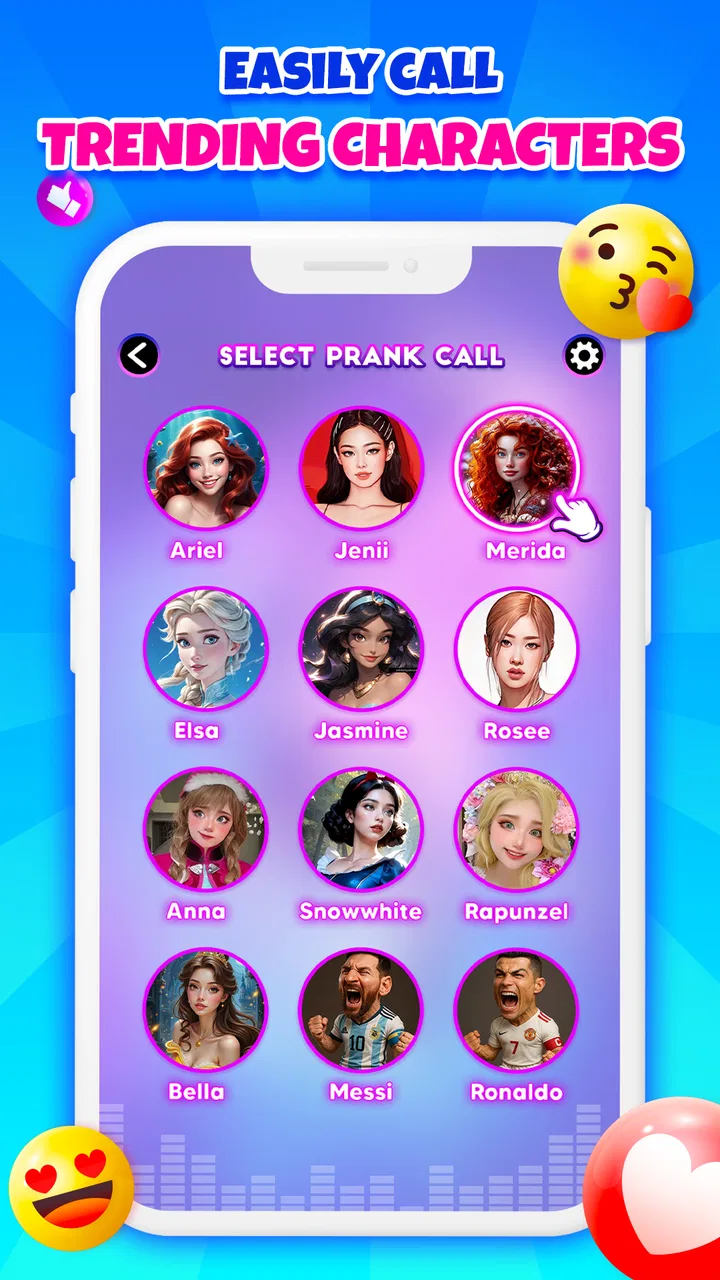
Trending Prank App
- 3.6
- Rating
- 5.00M
- Installs
- Free
- Price

 Analysis by App-foxy
I tried Trending Prank as a light entertainment app rather than as a serious communication tool, and that distinction matters from the first minute. Its appeal is simple: it turns familiar trending characters into staged prank calls and video-chat moments that can be shared with friends. The idea is easy to understand, the app is free, and the tone is aimed at casual fun rather than long sessions or complicated setup. Joy Buzz Games has positioned it for an Everyone 10+ audience, so it fits best in a family or friend-group setting where everyone understands that the conversations are fictional.
My overall impression is mixed but fairly positive. The concept is immediately accessible to people who enjoy short-form jokes, reaction videos, and playful surprises, yet the experience depends heavily on the quality of the individual prank scenario and on how comfortable the user is with quick visual and audio interactions. I would recommend it to someone who wants a simple way to create a funny moment, but I would not present it as a replacement for a normal video-chat service or as an app that offers deep entertainment on its own.
How the app feels to use in everyday situations
The most natural way to use this app is with another person nearby. Imagine waiting for a friend before going out, sitting with family after dinner, or looking for a quick joke to share in a group chat. Instead of searching through a large library of unrelated videos, you open the app, choose a character or scenario that catches your attention, and use the result as a short performance. That makes it more of a social prompt than a traditional entertainment platform.
You May Also Like

 Google Keep - Notes and lists
Google Keep’s Quiet Growth Shows the Appeal of Simpler Notes
As mobile work gets busier, Google Keep keeps winning a simple contest: capture a thought quickly, find it later, and get on with the day.

 Blood Strike: 2.5 Anniversary
Blood Strike’s Loadouts Turn Every Drop Into a Tactical Gamble
A close look at Blood Strike’s custom loadouts: how fast access to signature weapons reshapes its battle royale rhythm, rewards preparation, and narrows the gap between fights.

 Pandora - Music & Podcasts
Pandora’s Music Is Easy to Start, but Harder to Recover
Pandora’s strength is its low-effort path from a seed to a station. Its weak spot is how much confidence it asks you to place in connection, setup, and quiet recovery.

 8 Ball Pool
 Is Built on Rivalries, Rematches, and Routine
A close look at the rivalries, rematches, shared routines, and unanswered safety questions that turn a quick pool match into a persistent mobile community.

 Samsung Music
’s Quiet Strength Is Playing What You Already Own
Its reach comes less from spectacle than from dependable access to a personal library. That simplicity is both the app’s strongest retention engine and its ceiling.

 AccuWeather: Weather Radar
AccuWeather Review: A Quick, Clear Forecast for Everyday Decisions
For everyday plans, the best forecast is the one you can understand quickly. AccuWeather makes rain timing, radar, and local conditions easy to act on, with a few trade-offs.
More From Our News Desk



What I like about this format is that it lowers the effort needed to start a joke. There is no need to write a script, edit footage, or learn a complicated creative tool. The character supplies the central idea, while the user supplies the reaction and the audience. That division works well when the goal is a quick laugh. It also means the app is more enjoyable when used with people who already understand the prank context.
The drawback is that the novelty can fade quickly. A person who expects a large, constantly changing entertainment service may find the experience narrower than expected. The app’s store presence describes realistic prank calls and video chats from trending characters, so its strongest use is clearly the short, character-based interaction. If you want open-ended conversations, genuine calls, or a broad video catalog, a conventional messaging app, video platform, or social network will be a better fit.
Readability and navigation in a fast, visual experience
For this type of app, clear navigation is more important than a long feature list. The user should be able to understand what each character or prank option is meant to do without studying several screens. In my experience, the concept itself provides a useful advantage: the choices are entertainment prompts, not technical tools. Someone who is comfortable browsing visual content can usually understand the basic flow quickly.
That simplicity can help people who dislike dense menus or complicated creative software. A first-time user is not being asked to assemble a full video, manage a project, or configure a communication account. The central decision is closer to choosing a joke. I found that helpful when introducing the app to someone who wanted to participate without spending time learning a new platform.
Still, visual simplicity should not be confused with perfect readability. Character-focused interfaces often rely on images, short labels, and prominent controls. Users with reduced vision may need to move more slowly, enlarge the surrounding device display, or have another person read the available choices aloud. I would have preferred more confidence that every option communicates its purpose through text as well as imagery, because a prank app can become frustrating when the user cannot tell what will happen before starting it.
There is also a practical issue with the app’s entertainment style: some choices may be understandable only after the user recognizes the character or the trend being referenced. That creates a small knowledge barrier. Someone who does not follow current online characters may not know which option is likely to be funny, appropriate, or suitable for a particular group. I recommend previewing the wording and tone before showing a prank to younger relatives or people who are sensitive to surprise.
The app is free, which removes a major decision point for casual users. At the same time, free access can encourage people to install it spontaneously without first considering whether the recipient will enjoy a prank. My advice is to treat the selection screen as part of the joke: read the available description carefully, choose something recognizable, and avoid starting a call or video moment when the other person is busy, anxious, or unable to follow fast-moving content.
Motor and sensory considerations before starting a prank
Trending Prank is not the kind of app I would choose for someone who needs a completely hands-free or low-stimulation experience. The central appeal involves visual reactions and, depending on the selected interaction, audio or video-style presentation. A user who has difficulty tapping small controls, holding a phone steady, hearing spoken content, or processing sudden changes may need assistance from another person.
That does not make the app unusable for everyone with a disability. It means the context matters. A friend can handle the selection while the user enjoys the character moment. A family member can explain what is about to happen before the prank begins. Someone with hearing difficulty may still enjoy the visual side if the important information is visible, while someone with limited vision may prefer listening with a trusted person describing the screen. These are practical adaptations, not guarantees about built-in accessibility support.
Surprise is another sensory factor that deserves attention. A prank is designed to create a reaction, but sudden voices, fast movement, or an unexpected character appearance can be unpleasant for people with sensory sensitivities. I would not use it as an unannounced distraction around a person who dislikes loud sounds, abrupt visual effects, or unpredictable interactions. Asking first may reduce the surprise slightly, but it makes the experience more respectful and inclusive.
Motor demands can also affect the social timing. If the user needs extra time to select an option, position the phone, or understand the next screen, friends should not rush the process or laugh at the delay. The best version of this app is collaborative: one person can operate the phone while another chooses the idea and a third person reacts. That shared workflow makes the app more accessible than treating it as a one-person performance that must be completed quickly.
For children, adult supervision is sensible even though the age guidance is Everyone 10+. The age label gives a useful general boundary, but it does not tell you whether every character, joke, or reaction will suit a particular child. I would check the selected scenario personally, especially when the app is being used in a classroom, at a family gathering, or around children who interpret fictional calls literally.
Situational access: when it works and when it does not
The strongest setting for the app is a relaxed social environment with a stable internet connection, enough time to explain the joke, and people who enjoy playful performance. It can fill a few minutes during a visit or give friends an idea for a short recording. It is especially useful when nobody wants to download an editing suite or plan a complicated prank. The app supplies the premise, so the group can focus on the reaction.
I would avoid using it in places where sound or surprise could cause trouble. Public transport, a quiet waiting room, a workplace, a library, or a medical setting are poor choices for a character-based prank. Even a harmless joke can become embarrassing if a loud voice starts unexpectedly or another person is included without understanding what is happening. The app is entertainment, but its social effect depends on timing and consent.
It also deserves caution in remote interactions. A real friend may understand that the call is fictional, but a younger child, an older relative, or someone unfamiliar with online trends might believe the screen represents a genuine person. Before starting, I would explain that the character is part of an app and that the situation is staged. That small explanation protects the fun without turning the experience into a confusing deception.
People who rely on captions, transcripts, screen magnification, switch control, or voice navigation should test the basic flow with patience. I would not assume that a fast entertainment interface exposes every important action equally well to assistive technology. If a user cannot independently select a character or follow the visual presentation, another person may need to operate the phone. For a shared joke, that can be perfectly workable; for private independent use, it may be a significant limitation.
Compared with ordinary social media, the app has a narrower but more focused purpose. Social platforms offer more ways to adjust playback, read comments, pause content, or choose among different media formats, although they also bring more distractions and social pressure. Compared with a normal video-call app, Trending Prank is easier to use for a fictional character moment but unsuitable for real conversation. Compared with video-editing tools, it is far less demanding, but it gives the user much less control over the final result.
Small workflow choices that improve the experience
One useful habit is to choose the audience before choosing the character. If the recipient enjoys recognizable online personalities, a trending option may land well. If the group is less familiar with those references, a simpler and more visually obvious idea is safer. This reverses the usual impulse to pick the most exciting option first, and it prevents the joke from depending on knowledge that the audience does not have.
A second improvement is to make the first attempt a private test. I would run through the selected interaction with the phone volume at a comfortable level and check how quickly the content begins. That gives me a chance to decide whether the timing, voice, and visual intensity suit the person watching. It also avoids the awkward situation of discovering the tone only after the prank has started in front of a group.
A third tip is to use a two-person operating method. One person holds and controls the device, while the other watches for the recipient’s reaction and decides whether to continue. This is particularly helpful for users with motor limitations, slower reading speed, or sensory sensitivities. It also makes the prank less likely to become intrusive, because somebody can stop the interaction as soon as the joke stops being enjoyable.
Finally, I would treat the app as a short activity rather than something to leave running in the background. Its value comes from anticipation, selection, and reaction. Repeating the same style too many times can make the experience predictable, while spacing out the use keeps it more effective. That is a trade-off built into the concept: the app is convenient because it is focused, but the same focus limits its long-term variety for heavy users.
Remaining barriers and sensible boundaries
The biggest barrier is not technical complexity; it is the assumption that everyone enjoys being surprised. A prank can be funny only when the recipient feels safe and included. People with anxiety, communication difficulties, cognitive differences, or past negative experiences with unexpected calls may need a clear explanation beforehand. In those cases, the app can still be used as a character video or a shared viewing activity, but the “gotcha” element should be removed.
Another barrier is interpretation. Realistic presentation can make fictional content feel more convincing, particularly to children or people who are not familiar with app-based characters. I would never use it to impersonate a real person in a way that could cause fear, pressure, or reputational harm. Keeping the joke obviously playful is more important than making it maximally realistic.
There is also a difference between being technically able to open the app and being able to enjoy it independently. A person may be able to tap through the interface but still miss the joke because the character speaks too quickly, the visual cues are brief, or the context is unfamiliar. Inclusive use requires more than handing over the phone. It may involve describing the scene, pausing to explain the premise, adjusting the environment, or letting the user choose the pace.
Joy Buzz Games is the developer behind the app, which currently appears as version 2.3.4 and supports Android 7.1 or later. That broad operating-system reach is helpful for people using older compatible phones, although the actual comfort of the experience will still depend on the device’s screen, speakers, camera handling, and general performance. I would check those basics before planning a group activity around it.
The app has reached more than five million installs and holds an average rating of 3.7 from around 2.4 thousand ratings. Those figures suggest that it has found a substantial audience while also leaving room for mixed experiences. I read that as a reason to keep expectations realistic: the concept clearly appeals to many casual users, but it is not a universal fit, and the quality of a prank depends on the selected character and the people involved.
Who should use it, and who should skip it
I think Trending Prank is a good choice for friends who want a quick, low-effort joke and for families willing to supervise the experience. It can also work for someone who enjoys character-based entertainment but does not want to learn video editing. The free price makes experimentation easy, and the Everyone 10+ guidance gives parents a useful starting point for deciding whether it belongs on a shared device.
I would skip it if you want genuine calls, private communication, detailed customization, or a calm and predictable interface. It is also the wrong choice for pranks involving strangers, sensitive personal situations, or anyone who has not agreed to be part of the joke. A regular messaging or video-call app is better for real contact, while a curated video service is better for passive viewing and a full editing app is better for creative control.
My final view is that this is a focused entertainment tool with a clear social use, not an all-purpose media app. Its best quality is the low barrier between opening the app and creating a shared moment. Its main weakness is that accessibility and enjoyment depend heavily on the surrounding people, the environment, and the user’s ability to process quick audio-visual content. Use it with consent, preview the prank, and let the audience control the pace. Under those conditions, I can recommend it for occasional fun. Without them, the same realism that makes a prank amusing can make it uncomfortable, confusing, or simply inaccessible.
FAQs for Trending Prank App
01What is the main purpose of the Trending Prank App?
The Trending Prank App is designed to provide users with a variety of fun and harmless pranks to play on friends and family. It includes features such as fake calls, voice changers, and prank soundboards. The app aims to create laughter and entertainment without causing distress or harm to anyone involved.
02Is the Trending Prank App safe to use?
Yes, the Trending Prank App is generally safe to use as long as it is used responsibly. The app is designed for entertainment purposes and does not collect any personal data. However, users should ensure that the pranks remain light-hearted and do not offend or upset others.
03Are there in-app purchases in the Trending Prank App?
Yes, the Trending Prank App may offer in-app purchases to unlock additional features or remove ads. While the basic version of the app is often free, users can enhance their experience through these optional purchases. It's important to review the pricing and features before making any purchases.
04Does the app require an internet connection to function?
The Trending Prank App typically requires an internet connection for initial setup and to access certain features, such as downloading new prank sounds or updates. However, many pranks and features can be used offline once they have been downloaded or set up, offering flexibility in various environments.
05Can the app be used on both Android and iOS devices?
Yes, the Trending Prank App is available for both Android and iOS platforms. Users can download it from the Google Play Store or Apple App Store, ensuring compatibility with a wide range of devices. Be sure to check the app’s requirements for your specific device to ensure compatibility.
Pros
- User-friendly interface and easy navigation.
- Wide variety of prank sounds and effects.
- Regular updates with new prank features.
- Low battery consumption during use.
- No intrusive ads for uninterrupted fun.
Cons
- Limited free content; most features are paid.
- Occasional lag on older devices.
- Requires internet for some features.
- Prank sounds could be louder.
- No customization for prank notifications.

Trending Prank App
Gallery